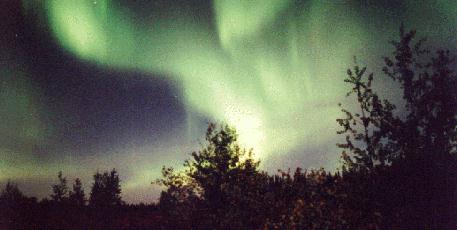
Report of Natural VLF Radio Recording Results, Descriptions of Auroral Displays, Geo-Magnetic Indices, Photographs, VLF Sound Files, and Propagation Observations.
By Stephen P. McGreevy
Primary Location
Grass River Provincial Park, Manitoba
22 August – 05 September 1996
Geographic Coordinates: 54° 40' N / 101° 10' W
Located 2 miles north of Simonhouse Lake and 1/3 mile south of Provincial Hwy 39, 5.5 miles (8.8 km) east of the junction of Hwy 10 and 39. Geomagnetic Latitude: ~64° N — a prime location for field-recording auroral-zone VLF radio phenomena and observing aurora.
Secondary Listening Sites (En Route South)
12 – 22 September 1996
Canyonlands NP, Utah: 12–13 Sept
Great Basin NP, Nevada: Upper Lehman Campground, 13–16 Sept
Angel Creek NFCG, Nevada: 7 mi SW of Wells, NV, 16–18 Sept
Black Rock Desert, Nevada: 19–22 Sept
Location of the primary VLF listening site in Grass River Provincial Park, Manitoba, Canada.
VLF Primary Receiver: McGreevy WR-4B E-field receiver with a 3-meter (10-foot) whip antenna mounted to the rear door of the van.
VLF Portable Receiver: Hand-held McGreevy WR-3E portable VLF receiver with an 85 cm (33-inch) whip antenna.
LF/HF Observation Rig: Kenwood R-1000 receiver with Yaesu FRT-7700 tuner and homebrew pre-amplifier. Connected to a 100-foot wire antenna (at 10–20 feet) for HF reception, and a 600-foot wire (1–3 feet above ground, pointed northeast) for LF/MF reception.
Portable Monitoring: Sangean ATS-808 receiver for mediumwave (MF) and high-frequency (HF) propagation checks.
Note: All times and dates are recorded in UTC (GMT/Z) and Central Daylight Time (CDT).
International Brightness Coefficient (IBC) Scale Reference
The IBC scale provides standard logarithmic measurements for auroral optical brightness:
IBC I
Brightness equivalent to the visual intensity of the Milky Way.
IBC II
Brightness equivalent to thin moonlit cirrus clouds (~10 times brighter than IBC I).
IBC III
Brightness equivalent to moonlit cumulus clouds (~100 times brighter than IBC I).
IBC IV
Extremely intense display providing total ground illumination equivalent to a full moon.
Expedition Log & Observation Records
Thursday, 22 August 1996
En Route to Grass River
1922 UTC / 2:30 PM CDT: ~40 miles (60 km) south of The Pas, Manitoba, at Hwy 10 turn-off to Springwater Picnic Area.
VLF Loud auroral hiss-band, occasional parallel discrete tones and "whines" audible in the fairly loud hissband. Occasional "ringing/chiming" sounds also heard (most unusual!). Recorded 20 minutes of excellent tape on cassette MBVLF-1 (Sides A & B).
Geomagnetic Indices (22 Aug): 3-hourly planetary K-index (0000–2100 UT): 1 1 1 1 1 2 2 2 (Quiet to unsettled). Boulder K2 at 1800 UTC. Solar Flux = 73, SSN = 12, >2 MeV Electron Fluence = 2.1E+07 (Moderate). No proton events. X-ray background: A4.3.
Friday, 23 August 1996
VLF Camp Arrival & Full-Sky Auroral Display
0006 UTC / 7:06 PM CDT (22 Aug): Arrival at the "VLF Camp" listening site in Grass River Provincial Park. Mediumwave reception noted strong Norway on 1314 kHz at 0230 UT, plus weak Talk Radio UK on 1053 kHz under splatter from Mexico and Cuba on 1050 kHz.
0355 UTC / 10:55 PM CDT (22 Aug):
VLF Weak hissband, a few risers (chorus), tweeks, light to moderate static, occasional weak whistler. Planetary & Boulder K = 2.
Aurora At 0420 UT, an auroral "arch" (arc) is visible from northwest to northeast horizon, ~20° altitude at maximum, averaging IBC I to II. The arch is developing rayed striations in the northeast quadrant at IBC II+ levels.
Typical quiescent auroral arc/arch visible to the north before active substorm onset. Photo by S. P. McGreevy (25 August 1996).
0530 UTC / 12:30 AM CDT:
Aurora The auroral arch is straight overhead with curtains, striations, and a bright corona forming. By 0540 UT, the aurora is dazzling and full-sky (IBC III to nearly IBC IV). Photographed with Pentax ME-Super (35mm lens), capturing Type C greenish and Type A reddish-purple auroral colors.
VLF Surprisingly quiet despite full-sky aurora — only weak hiss and ringing tones. Active, discrete auroral displays generate relatively little ground VLF noise; major chorus emissions originate in the magnetospheric bow-shock region and propagate via whistler-mode paths.
Full-sky auroral curtains over Grass River Provincial Park, Manitoba. Photo by Stephen P. McGreevy.
Geomagnetic Indices (23 Aug): 3-hourly K-index (0000–2100 UT): 2 4 5 4 3 1 2 2 (Quiet to major storm levels). Solar Flux = 74, SSN = 24, >2 MeV Electron Fluence = 1.4E+06 (Low). X-ray background: B2.9.
0836 – 0915 UTC / 3:30 – 4:15 AM CDT:
VLF Chorus onset with low and high chirps, squawks, and hiss. By 0905 UT, a rapidly increasing number of high-latitude "nose" whistlers are descending to ~2 kHz. Chorus intensifying noticeably by 0915 UT (Tape MBVLF-3, Side A).
1108 – 2223 UTC (Morning through Late Afternoon):
VLF Loud chorus and hiss undulating with geomagnetic micropulsations. Echoing chorus trains at 1125 UT. By 1356 UT, chorus features low-frequency "fallers" (<400 Hz) sounding like "dweeeooop!". At 1444 UT, chorus is extremely loud with squawking risers. Spectacular high-quality recording sessions continued non-stop on cassettes MBVLF-4, MBVLF-5, and MBVLF-6.
Daytime view of the listening site and van in the northern boreal forest of Grass River Provincial Park, MB.
Saturday, 24 August 1996
Polar Chorus & Lightning Static Interactions
Geomagnetic Indices (24 Aug): 3-hourly K-index (0000–2100 UT): 2 2 3 2 1 2 2 3 (Quiet to unsettled). Solar Flux = 75, SSN = 22, Electron Fluence = 1.5E+06 (Low). X-ray background: B1.2.
0535 UTC / 12:35 AM CDT:
Aurora Gibbous moon. Bright auroral arch (IBC II to III) in northern sky 20–25° above horizon, rapidly developing rays and striations.
VLF Static tweeks, weak power-line hum, faint hiss, and strange "ricochet" fast whistlers occurring 50–100 ms after strong static bursts.
1039 – 1600 UTC:
VLF Low hissband and loud chorus "squawks". By 1442 UT, low-frequency "ghostly tones" reaching down to 300 Hz ("polar chorus"). By 1601 UT, strong static crashes from storms 400 miles south triggered 2–5 second bursts of chorus trains 2–3 seconds after each crash (Tapes MBVLF-8 & MBVLF-9A).
Sunday, 25 August 1996
Green Auroral Arch & Undulating Chorus
Geomagnetic Indices (25 Aug): 3-hourly K-index (0000–2100 UT): 4 3 4 4 3 3 2 2 (Quiet to active). Solar Flux = 75, SSN = 14, Electron Fluence = 5.9E+06 (Low). X-ray background: B1.1.
0400 – 0515 UTC / 11:00 PM – 12:15 AM CDT:
Aurora Bright green auroral arc (IBC II to III) forming a flattened rainbow across northern sky at 15° altitude. Stars visible through the arch. By 0415 UT, arch rose to 25° with rayed striations.
VLF Faint hissband, sferics, and minor power-line hum from transmission line 4.2 miles west.
1353 – 2015 UTC:
VLF Chorus build-up with low "roaring" hissband and 2 kHz chorus outbursts accompanied by "auroral sizzle". Loud riser outbursts at 1932 UT coinciding with substorm activity (Tape MBVLF-10).
Monday, 26 August 1996
Corona at Zenith & High Electron Fluence
Geomagnetic Indices (26 Aug): 3-hourly K-index (0000–2100 UT): 3 4 4 3 1 1 3 2 (Quiet to active). Solar Flux = 74, SSN = 16, Electron Fluence = 2.0E+08 (Moderate-High). X-ray background: A6.6.
0233 – 0539 UTC:
Aurora Auroral arc developed kinks, rays, and vertical pillars (IBC II–III). Corona formed overhead at magnetic zenith by 0539 UT.
Radio Propagation WWV 5.000 MHz experienced heavy auroral flutter fading. European mediumwave degraded due to D-layer absorption (Norway 1314 down 10 dB).
Auroral curtain extending down toward the horizon, observed 26 August 1996. Photo by S. P. McGreevy.
1317 – 2001 UTC:
VLF Chorus returned with loud, low-pitched whoops, squawks, and continuous 1 kHz risers (Tape MBVLF-11). Similar to central Alaska recordings from September 1995.
Tuesday, 27 August 1996
All-Day Chorus & Multi-Banded Auroral Striations
Geomagnetic Indices (27 Aug): 3-hourly K-index (0000–2100 UT): 3 3 4 3 2 3 3 3 (Quiet to unsettled). Solar Flux = 74, SSN = 13, Electron Fluence = 1.3E+08 (Moderate-High). X-ray background: A6.7.
0301 – 0340 UTC:
Aurora Arc split into multiple parallel bands. Five parallel striated/rayed bands completely filled the northern sky almost to zenith by 0340 UT (IBC II+ to III).
VLF All-day chorus event: continuous whooping risers, low-pitched roaring hiss, and "hooks" from 1208 UT past 2239 UT (Tapes MBVLF-12 & MBVLF-13).
WR-4B VLF receiver control box, field log notes, and Marantz PMD-212 cassette recorder inside the listening van.
Wednesday, 28 August 1996
Whistler Shower & "Jet-Engine" Auroral Hiss
Geomagnetic Indices (28 Aug): 3-hourly K-index (0000–2100 UT): 3 3 3 3 3 3 4 3 (Unsettled to active). Solar Flux = 74, SSN = 13, Electron Fluence = 1.9E+08 (Moderate-High). X-ray background: A6.9.
0715 – 0732 UTC:
Aurora Sudden brightening of auroral arc to IBC III+, triggering frying/sizzling hiss sounds.
VLF Major whistler outbreak reaching 20–30 per minute (both pure-tone and diffuse). Dense low-whooping chorus barrage at 0732 UT (Tape MBVLF-14). At 1637 UT, roaring hiss reached extreme levels resembling a jet engine.
Thursday, 29 August 1996
Major Geomagnetic Storm (Kp = 6) & Southern Horizon Aurora
Geomagnetic Indices (29 Aug): 3-hourly K-index (0000–2100 UT): 4 6 6 5 4 3 3 4 (Minor to Major Storm). Solar Flux = 74, SSN = 20, Electron Fluence = 5.6E+07 (Moderate). X-ray background: A4.7.
0230 – 0330 UTC:
Aurora Major southward expansion of the auroral oval. Primary arc hung across the southern sky at 30° altitude directly below the full moon (IBC IV brightness). Corona formed at zenith; hydrogen arc shifted to the southern sky.
VLF Auroral hiss accompanied peak optical display. By 2053 UT, sudden Solar Wind impulse triggered a dramatic 10–15 dB rise in hissband intensity within minutes (Tape MBVLF-16).
Radio Propagation Auroral flutter on FM broadcast stations (150–300 miles distance). Transatlantic LW/MW enhanced: Norway 1314, Atlantic 252 (252 kHz), BBC 198 (198 kHz), and Virgin 1215 were very strong.
Friday, 30 August 1996
Echoing Chorus Trains & Transatlantic MW Peak
Geomagnetic Indices (30 Aug): 3-hourly K-index (0000–2100 UT): 5 3 4 1 1 2 2 3 (Quiet to Minor Storm). Solar Flux = 73, SSN = 16, Electron Fluence = 4.1E+08 (Moderate-High). X-ray background: A5.7.
1652 – 1800 UTC:
VLF Echoing chorus trains repeatedly increased in frequency over 5-second intervals, mixed with parallel "hook" emissions and diffuse whistlers (Tape MBVLF-17).
Radio Propagation Exceptional European mediumwave conditions at 0240 UT: Virgin 1215 UK had local-quality audio for 10 minutes (Don Henley song), alongside giant signals from BBC Wales (882 kHz), Talk Radio UK (1053/1089 kHz), and Norway (1314 kHz).
Two parallel auroral curtains observed over Grass River Provincial Park. Photo by S. P. McGreevy.
Saturday, 31 August 1996
Dense Morning Chorus & Approaching Front
Geomagnetic Indices (31 Aug): 3-hourly K-index (0000–2100 UT): 3 3 4 4 3 2 2 2 (Unsettled to Active). Solar Flux = 76, SSN = 26, Electron Fluence = 4.4E+08 (Moderate-High). X-ray background: A5.2.
1704 – 2030 UTC:
VLF Dense whooping chorus (500 ms to 1 second duration) with outbursts every 5–7 seconds (Tape MBVLF-18). Static intensity steadily increased through the evening as lightning cells approached from the southwest.
Sunday, 01 September 1996
Severe Boreal Severe Lightning Storm & Field Emergency
Geomagnetic Indices (01 Sept): 3-hourly K-index (0000–2100 UT): 2 1 1 3 1 1 1 1 (Quiet to slightly unsettled). Solar Flux = 74, SSN = 11, Electron Fluence = 7.0E+08 (Moderate-High). X-ray background: A8.5.
0545 – 0800 UTC / 12:45 – 3:00 AM CDT:
VLF Field Note Cold front lightning storm hit Grass River camp. WR-4B whip stowed; handheld WR-3E used to record hook emissions following severe sferics. Van battery was dead due to heavy 10-day monitoring drain; vehicle was immobilized during storm. Battery successfully recharged later in the day using an 8-watt solar panel.
VLF Despite low geomagnetic index (Boulder K = 1), multi-banded loud chorus surges occurred. Tested a 600-foot longwire antenna against the 3-meter whip: longwire picked up excessive AC power-line hum from 4.2 miles away, demonstrating the superior immunity of short vertical E-field whips in VLF reception.