Polar is the first satellite to have 3 orthogonal electric antennas (E_u, E_v, and E_z), 3 triaxial magnetic search coils, and a magnetic loop antenna, as well as an advanced plasma wave instrument [Gurnett et al., 1995]. This combination can potentially provide the polarization and direction of arrival of a signal without any prior assumptions.
The Plasma Wave Instrument (PWI) on the POLAR spacecraft is designed to
provide measurements of plasma waves in the Earth's polar regions over the
fequency range from 0.1 Hz to 800 kHz. Five receiver systems are used to
process
the data: a wideband receiver, a high-frequency waveform receiver (HFWR),
a low-
frequency waveform receiver, two multichannel analyzers, and a pair of
sweep frequency receivers (SFR). For the high frequency emissions of
interest here, the SFR is of special interest. The SFR has a frequency range
from 26 Hz to 808 kHz in 5 frequency bands. The frequency resolution is
about 3% at the higher frequencies. In the log mode a full frequency spectrum
can be obtained every 33 seconds. From 12.5 kHz to 808 kHz, of interest in
this study, a full frequency spectrum can be obtained every 2.4 seconds.
The wideband receiver (WBR) provides high-resolution waveform data, and
is programmable allowing the selection of 11, 22 or 90 kHz bandwidths with a
lower band edge (base frequency) at 0, 125, 250, and 500 kHz. In the 90 kHz
bandwidth mode the samping rate is 249 kHz. The low frequency waveform
receiver (LFWR) measures electric and magnetic field waveforms in the frequency
range of 0.1 Hz to 25 Hz at a 100 Hz sampling rate. The duty cycle of this
receiver is typically to take a 2.5 second snapshot of data every 25 seconds.
The high frequency waveform receiver (HFWR) measures waveform data over the
frequency range of 20 Hz to 25 kHz, but also operates with a 2 kHz or 16 kHz
filter. The sampling rate is 71.43 kHz in the 25 kHz mode. Typically,
the receiver obtains a 0.5 second snapshot of data every 128 seconds.
The Electron and Ion Hot Plasma Instrument (HYDRA) [Scudder et al., 1995]
is an experimental three-dimensional hot plasma instrument for the POLAR
spacecraft. It consists of a suite of particle analyzers that sample the
velocity space of electron and ions between ~ 2 keV/q to 35 keV/q in three
dimensions, with a routine time resolution of 1.5 seconds. The satellite
has been designed specifically to study accelerated plasmas such as in the
cusp and auroral regions.
We selected two Polar auroral region passes for presentation, one each
for the Northern and Southern hemispheres.
The Polar spacecraft observations are presented in a limited format due to
the preponderance of data.
This is a northern hemisphere nightside pass that intercepts the auroral region in the range ~6.5 R_E < r < ~7.5 R_E. During this time the ratio of plasma to cyclotron frequency, f_p/f_ce is probably >~ 1 based on the fact that the whistler mode emission is observed to cutoff at f_ce. It is known that whistler mode emission has an upper frequency cutoff at either f_p or f_ce, whichever is lowest. The particle data from the HYDRA instrument measured electron density during this period in the range of 0.1 < n < 0.4 cm-3, which is consistent with f_p/f_ce >~ 1.
In Plate 1 we display a frequency-vs-time spectrogram with the electric field intensity color-coded. The data are from the SFR on board PWI. The plot extends over 80 minutes and includes rather intense electrostatic and electromagnetic (magnetic oscillations not shown) for this pass. The white line indicates the local electron cyclotron frequency. The intense emission begins near the poleward edge of the auroral region at about 14:50 and extends to about 15:44. The particle data from the HYDRA instrument on board Polar (not shown) confirm the poleward edge of the auroral precipitation region (boundary plasma sheet) near 14:50 and also the equatorward edge of the auroral region near 15:45 where more energetic central plasma sheet precipitation begins.
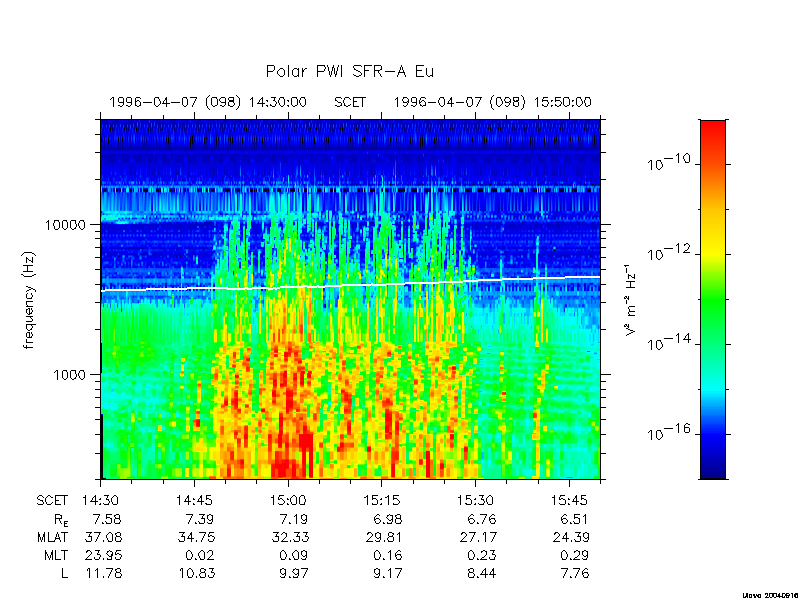 Plate 1
For this pass the Polar spacecraft HFWR was in
a mode to monitor high resolution waveforms up to 16 kHz. The receiver
sampled the data in 58 msec snapshots every 128 seconds.
We have selected for presentation a couple of time intervals where solitary waves are observed. The first time interval is seen in Figure 1 where we display the electric and magnetic field data in a multi-panel presentation in field-aligned coordinates for a 28 ms snapshot starting at 14:51:468. The top three panels of electric field show two significant waveforms, electrostatic electron cyclotron (EEC) waves at high frequency, with f > f_ce. These waves are often observed on Polar northern hemisphere passes when f_p/f_ce >~1 [cf. Menietti et al. 2002]. Superimposed on these waves in panel 3, E_par, are the solitary wave (SW) signatures. The correlation of the SWs with EEC waves has been pointed out by Menietti et al. [2004] for the magnetopause. Here we note that the SWs are observed only in E_par.
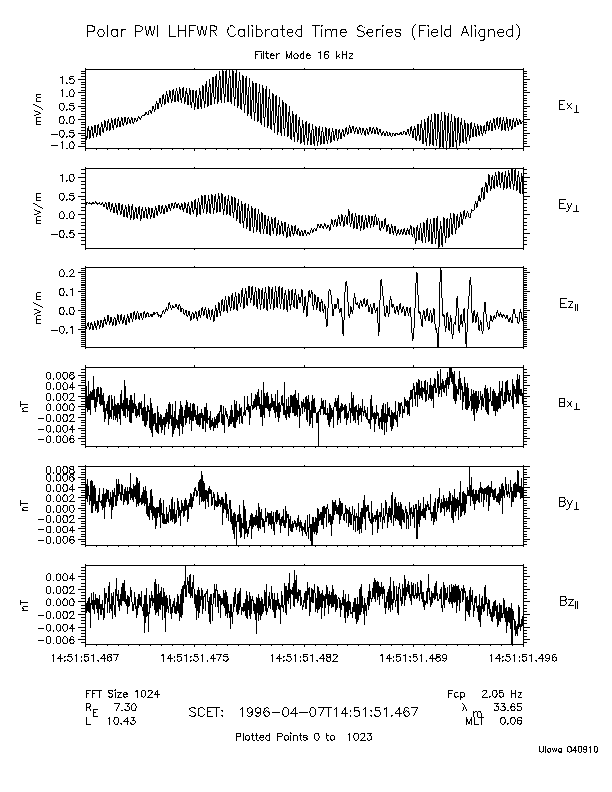 Figure 1
The next series of data for this pass is shown in Figure 2 for the time interval starting at 15:04:44.296. Solitary wave structures are observed in all three electric field components with the largest fields generally, but not always, in E_perp. Note the absence of EEC waves for this time interval. The magnetic field plotted at this time is not meaningful due to a data gap.
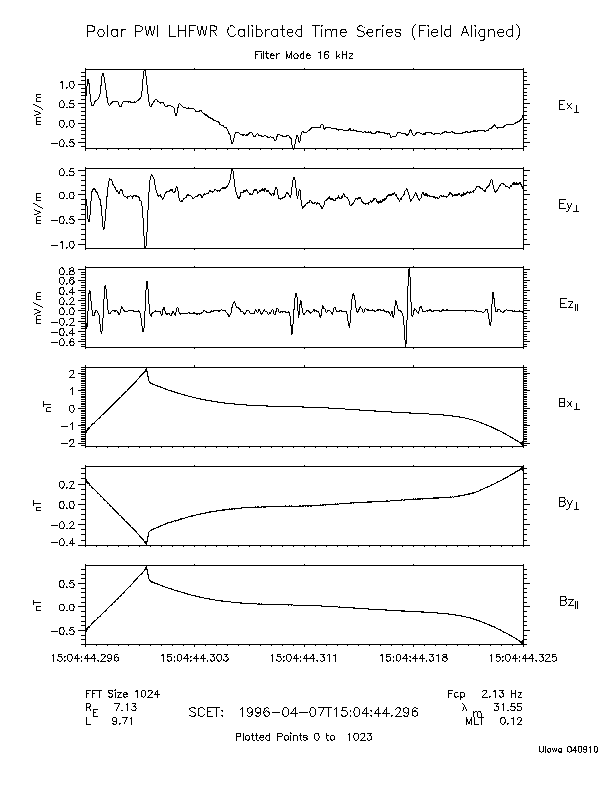 Figure 2
Finally for this pass we show a 20 msec snapshot of data starting at 15:41:13.896, near the equatorward edge of the auroral region (Figure 3). Here we observe another series of solitary wave structures quite similar to those of Figure 2. Note that the monopolar structures observed in E_perp are typically larger than the corresponding E_par (the scales on each axis is different). Near 15:51 EEC waves are again observed (not shown) and solitary wave structures are also present with these waves.
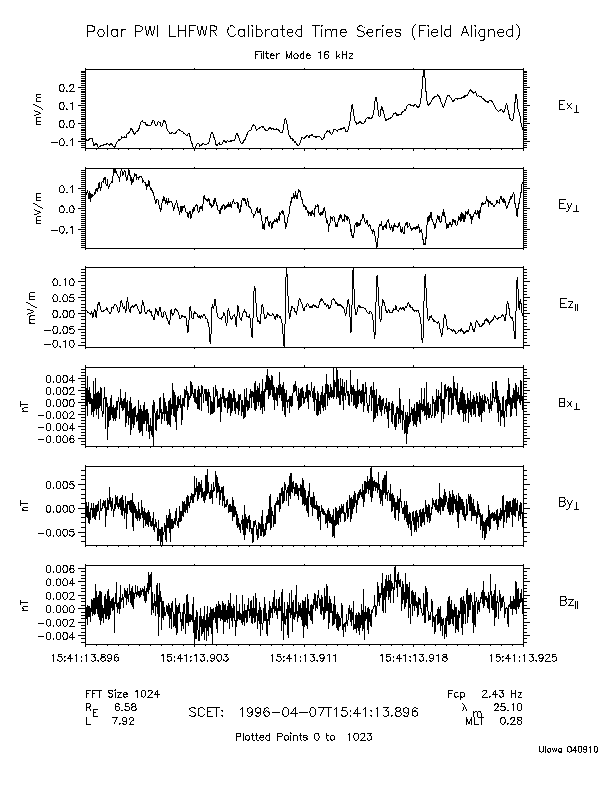 Figure 3
The Polar spacecraft intercepted the southern, nightside auroral region near perigee and therefore was close to the region of most intense electric fields on April 9, 1996 near 23:15. Particle data from HYDRA on board Polar (not shown) indicate central plasma sheet particles are encountered near 23:17 and become most intense near 23:24. The discrete precipitation characteristic of the auroral acceleration region begins near 23:26 and continues until about 23:35 where the poleward edge of the boundary plasma sheet is observed. In Plate 2 we display the electric field intensities from the PWI in a format similar to that of Plate 1. The electric fields show the characteristic "funnel" signature of auroral whistler mode emission and intense electrostatic emission as well [cf. Gurnett et al., 1983]. Auroral kilometric emission at frequencies above the cyclotron frquency are also observed during this pass. The Polar satellite is near the source region of this emission for this perigee pass.
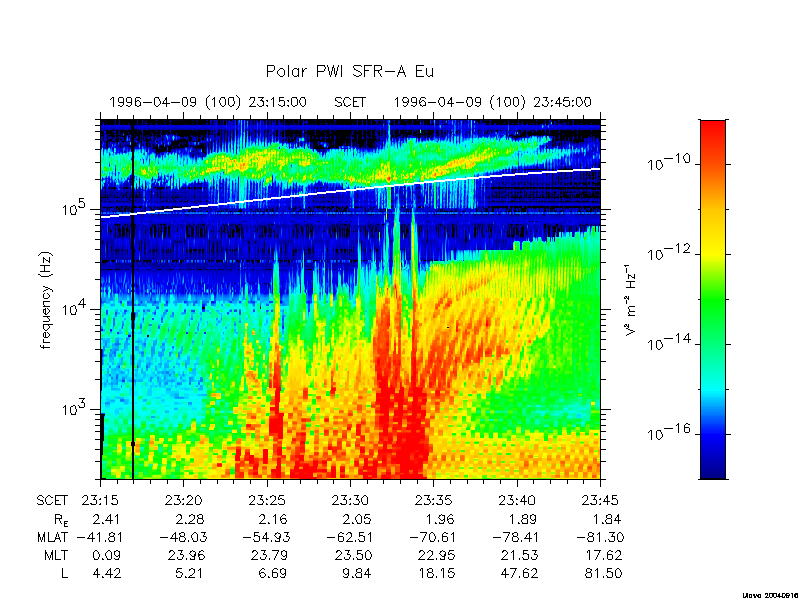 Plate 2
The field strengths for this pass are considerably larger than those of the previous pass because of the lower spacecraft altitude. Note the spacecraft radial distance is near 2 r_E for this pass. The spacecraft approaches the southern auroral region from the equatorward edge and begins to encounter particle preciptation near 23:23. In Figure 4 we display a 29 msec multipanel plot of the waveform data for the electric and magnetic fields starting at 23:23:35.456. The electric field data show distinct solitary wave structures in E_par and E_perp, with E_perp > E_par. This was typical for the SW structures observed during this pass. We also note that because of the intensity of the waves for this low-altitude auroral pass, the electric field amplitudes sometimes saturated the receiver.
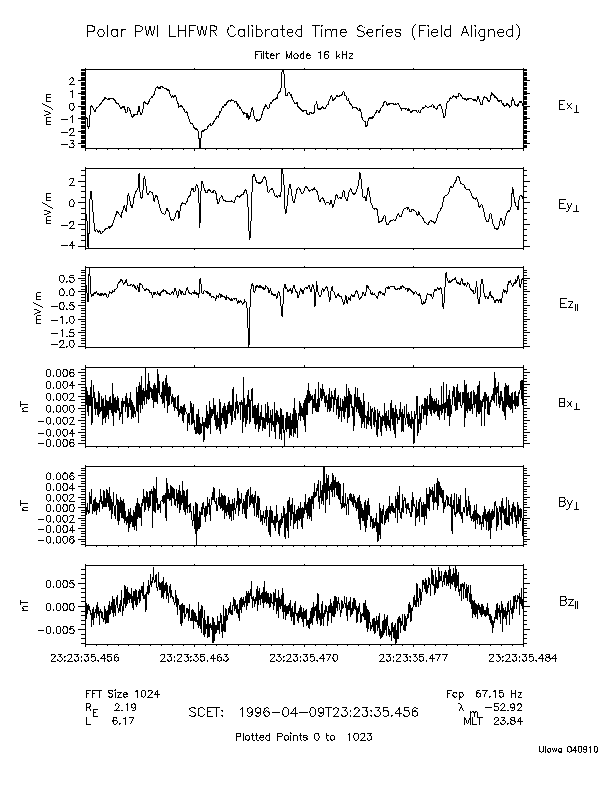 Figure 4
Because the PWI instrument did not operate in a continuous data stream mode for the high frequency waveform receivers, it is not possible to obtain an absolute value of occurrence probability of SW wave structures for the passes observed. However, we can comment on the occurrence of such structures during the observations. For the 16 kHz mode of the HFWR used for both of the passes reported in Figures 1 - 4, the sampling was discontinuous with 57 msec snapshots every 128 seconds as noted above. For both passes the HFWR operated at times when intense broadbanded plasma wave structures were observed by the swept-frequency receiver (SFR). There were periods when these broadbanded emissions occurred simultaneously with the SW structures, but there were also many periods when they did not.
For the pass of April 7, 1996, between 14:41 and 15:56 there were 72 28 msec snapshots of data sampled by the HFWR receiver. For this time interval the SFR observed rather intense broadbanded emission in the electric field antenna almost continuously. Of these, there were 16 snapshots containing clear signatures of solitary wave structures, and 8 others containing turbulent and possible examples of SW signatures.
For the pass of April 9, 1996, between 23:21 and 23:37 there were 32 28 msec snapshots of data sampled by the HFWR. For this time interval the SFR also observed almost continuously rather intense broadbanded emission in the electric field antenna. Of these, there were 4 snapshots containing clear examples of SW signatures, and 4 more containing turbulent and likely examples of SW signatures.
This research was supported by NASA through grant NAG511942 with NASA/ Goddard Space Flight Center.