October 1992, pp. 136-137
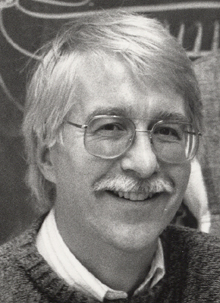
In Memoriam: Christoph K. Goertz
|
PHYSICS TODAY
October 1992, pp. 136-137 In Memoriam: Christoph K. Goertz |
|
Christoph K. Goertz, Professor of Physics and Astronomy at the University of Iowa, was killed during the shooting incident that occurred at the University of Iowa on November 1, 1991. His many friends and colleagues in the space plasma physics community have suffered a great loss which will be felt for many years. Chris was born in Danzig, Germany, on June 1, 1944. He received his Diplom Physiker from the Technische Universitat Berlin, Berlin, Germany, in 1969, and his Ph.D. in Physics from Rhodes University, Grahamstown, South Africa, in 1972, under the direction of Prof. T. A. Gledhill. After a short post-doctoral period at Rhodes, he accepted a position at the University of Iowa, first as a research associate in 1973, and then as an assistant professor beginning in 1974. In 1981 he was promoted to professor, a position he held until his death.
Chris' arrival at the University of Iowa occurred during a period of rapid advances in space physics. During this time, the Pioneer 10 and 11 spacecraft were providing the first close-up observations of the magnetosphere of Jupiter. Chris quickly became involved in the interpretation of the Pioneer energetic charged particle data, working in collaboration with Professor James A. Van Allen. This early research set the stage for a brilliant career in which he became one of the world's leading theorists in the rapidly growing field of space plasma physics. His primary interests were in planetary magnetospheres, particularly those of the outer planets, where he played a leading role in the analysis and interpretation of data from the flybys of Jupiter, Saturn, Uranus, and Neptune. He was extremely innovative and imaginative. In the course of his investigations he advanced many new ideas concerning wave-particle interactions, the diffusion of charged particles in radiation belts, kinetic Alfven waves, double-layers, and critical ionization velocity phenomena. His skills ranged from the development of simple conceptual models to the detailed analysis of complex systems of interacting particles and fields using numerical simulations. At the time of his death he was pioneering an entirely new area of space plasma physics concerned with the interaction of dust with hot plasmas. These interactions are thought to be an important factor in the evolution of Saturn's rings.
Chris was an outstanding lecturer, a popular teacher, and an able advisor to numerous graduate students. In addition to his research activities, he also played an important service role, having served on several national and international committees involved with the direction and future of space physics research, and was the senior editor of the Journal of Geophysical Research (Space Physics). During his career he also worked for short periods as a visiting scientist at several other laboratories both in the United States and in Germany, and was recently elected as an external scientific member of the Max-Planck-Institut fuer extraterrestrische Physik, Garching, Germany.
Chris was one of the most outstanding space plasma theorists of our time, and his enthusiastic discussions, insightful comments, and active participation will be sorely missed by all.
Don Gurnett
Department of Physics and Astronomy
University of Iowa
Glenn Joyce
Plasma Physics Division
Naval Research Laboratory
Return to D.A. Gurnett publications