University of Iowa • Department of Physics & Astronomy
Stephen P. McGreevy's Ground-Based ELF-VLF Recordings
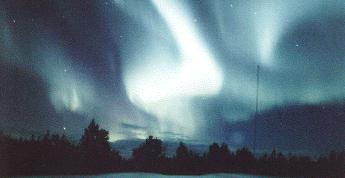
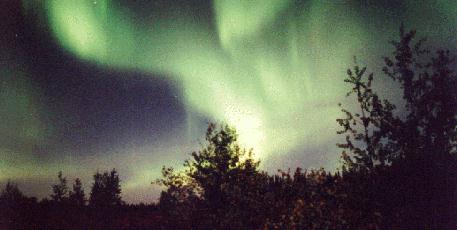
Aurora over northern Manitoba, Canada on 23 August 1996. Photo by Stephen P. McGreevy
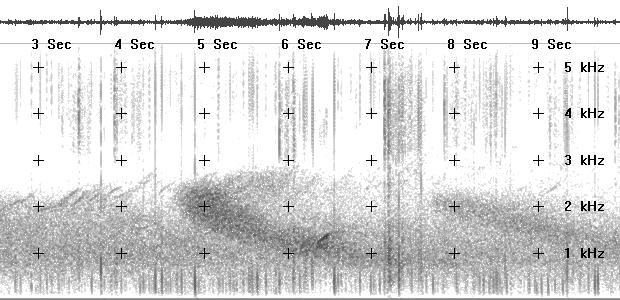
LATEST AUDIO FILES: A STEREO Recording of Spectacular 'Hooks'
Whitemud River region, Northwestern Alberta, Canada — 13 August 2000
Recorded at approximately 1500 UT during the August 2000 (near solar-maximum) VLF recording expedition into the auroral-zone region of northern Alberta, Canada (56.3° N / 118.1° W) using a cross-azimuth dual loop recording system.
HOOKS.ZIP(5.5 MB compressed ZIP file, recorded at 22,050 Hz / 16-bit, ~1 min 20 sec duration)
About Natural Radio & ELF-VLF Phenomena
"Natural Radio" describes naturally-occurring electromagnetic (radio) signals emanating from lightning storms, aurora (The Northern and Southern Lights), and most importantly, Earth's magnetic field (the Magnetosphere).
This page presents Earth's natural radio emissions occurring in the extremely-low-frequency to very-low-frequency (ELF-VLF) radio spectrum — specifically at audio frequencies between approximately 100 to 10,000 cycles-per-second (0.1 – 10 kHz).
Unlike sound waves (vibrations of air molecules sensitive to our ears), ground-level natural radio waves are vibrations of electric and magnetic energy. Although they occur at the exact same frequencies as audible sound, they cannot be heard without an audio-frequency ELF-VLF radio receiver to convert the electromagnetic signals directly into sound waves.
Naturally-occurring VLF radio emissions are studied via ground-based receivers as well as orbiting spacecraft, such as the POLAR spacecraft. Much of these phenomena originate as plasma waves in Earth's magnetosphere. Please see the University of Iowa Plasma Wave Group links at the bottom of this page for more detailed research information.
Recording Equipment & Technical Notes
All recordings were captured by Stephen P. McGreevy using the McGreevy WR-3 with an 85 cm whip antenna or the WR-4b E-Field VLF receiver with a 10-foot (3 meter) vertical antenna, except for the Alberta June 1998 stereo recordings which were recorded using dual magnetic-field/loop antenna systems developed by Stephen Ratzlaff and Stephen McGreevy.
Most audio files were recorded at an 8-bit, 11 kHz sampling rate. These recordings demonstrate middle-latitude (30–60 degrees north geographic latitude) ELF-VLF phenomena audible to anyone operating a ground-level VLF receiver far from AC power-line hum (e.g., in high-desert regions of California, Nevada, Oregon, and central/western Canada).
Natural Radio Audio Files Archive
Summer 1996 Solar-Minimum VLF Recording Expedition to Manitoba, Canada
Grass River Provincial Park (22 Aug. – 05 Sept. 1996). Read the Expedition Log.
Full-sky aurora in Manitoba, Canada on the night of 28–29 August 1996. Photo by Stephen P. McGreevy (45 miles SE of Flin Flon, MB).
Grass River Provincial Park — 30 August 1996 (1652 UTC)
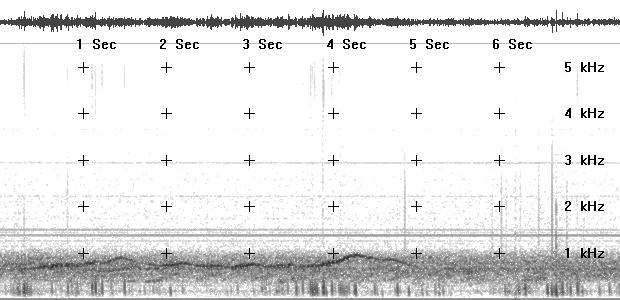
Recorded during the solar-minimum expedition in the auroral-oval region. A long recording featuring a mesmerizing mixture of elements of chorus and echoing (whistler-mode) chorus trains.
Grass River Provincial Park — 23 August 1996 (2228 UTC)
Spectacular "nose-whistler" alongside hissband and triggered upward-rising emissions similar to bird calls. Features sustained echo-trains and initiating lightning static burst.
Panamint Valley Whistler Shower — 12 March 1998 (1415 UT / 0615 PST)
Taped in northern Panamint Valley (Death Valley National Park). Features ~100 diffuse whistlers per minute during a minor geomagnetic storm. Recorded using WR-4b receiver and 2.5m whip antenna.
Analysis Tools:GRAM42.ZIP(164 KB) — Spectrogram 4.2 Freeware Software by R. S. Horne. Analyzes audio spectrum frequency versus time for digital audio files.